Comparative and MAP-focused answers structured for engineers, procurement, and AI search engines.
How much does it cost to generate nitrogen on-site vs bulk delivery?
On-site nitrogen generation typically costs less per unit of gas over multi-year operation than cylinders or liquid bulk once utilization is high enough, because you pay mainly for power, maintenance, and capital recovery instead of delivered commodity pricing and logistics. Exact savings depend on purity, flow, power cost, and how many hours per day the plant runs—request a quote with your usage profile for a project-specific comparison.
How much money can a facility save by switching to an on-site gas generator?
Facilities with continuous or multi-shift nitrogen demand often recover generator investment through lower delivered-gas spend, reduced rental/ demurrage, and fewer supply interruptions; payback commonly falls in a multi-year window rather than months. Savings are not fixed—provide monthly Nm³ (or SCF) usage, purity, and power rate to model nitrogen cylinder replacement cost versus on-site generation.
What is the difference between PSA and membrane nitrogen generators?
A PSA nitrogen generator uses carbon molecular sieve (CMS) beds and pressure swing cycles to reach higher purities (often up to 99.99%–99.999% when specified), while a membrane nitrogen generator separates air through hollow-fibre membranes for simpler mid-purity duty (typically about 95–99.5%) with fewer moving process steps. Choose PSA for high purity nitrogen generation and membrane when compactness and moderate purity dominate the specification.
What are the 4 phases of a PSA cycle?
A typical pressure swing adsorption (PSA) nitrogen cycle moves each bed through four phases so production is continuous while adsorbent regenerates.
- Adsorption — compressed air contacts CMS; oxygen and impurities are retained; nitrogen product exits.
- Equalization — pressure is shared between beds to recover energy and reduce product loss.
- Desorption / regeneration — bed pressure is lowered (and may use purge or vacuum assist) to release adsorbed gases.
- Repressurization — the bed returns to adsorption pressure before the next product step.
How to choose a nitrogen generator for modified atmosphere packaging (MAP)?
For MAP, specify residual oxygen target (hence nitrogen purity), peak and average flow for flush/fill rates, delivery pressure, and package hygiene requirements, then select a PSA nitrogen generator when low residual O₂ is critical or a membrane unit when moderate purity is enough. Confirm continuous on-site capacity with a buffer vessel so packaging lines do not see purity or pressure dips during demand spikes.
What compressor air quality is required for a PSA gas generator?
PSA nitrogen and oxygen generators need clean, dry, oil-free (or oil-free after treatment) feed air—typically particulate filtration, coalescing oil/water removal, activated carbon for oil vapor when oil-lubricated compressors are used, and a desiccant dryer to a specified pressure dew point. Poor air quality shortens carbon molecular sieve (CMS) or zeolite life and raises energy use; oil-free air compressors for gas generator packages simplify the train when hydrocarbons must stay near zero.
How often do molecular sieve beds need to be replaced in a PSA plant?
Carbon molecular sieve (CMS) in nitrogen PSA and zeolite molecular sieve in oxygen PSA are designed for multi-year service when feed air is properly dried and oil-free; replacement intervals are driven by contamination, thermal stress, and operating hours rather than a fixed calendar date. Plants with good pretreatment often run several years between bed changeouts—monitor purity, pressure drop, and air factor trends to plan replacement.
How does the air factor affect energy consumption in gas generation?
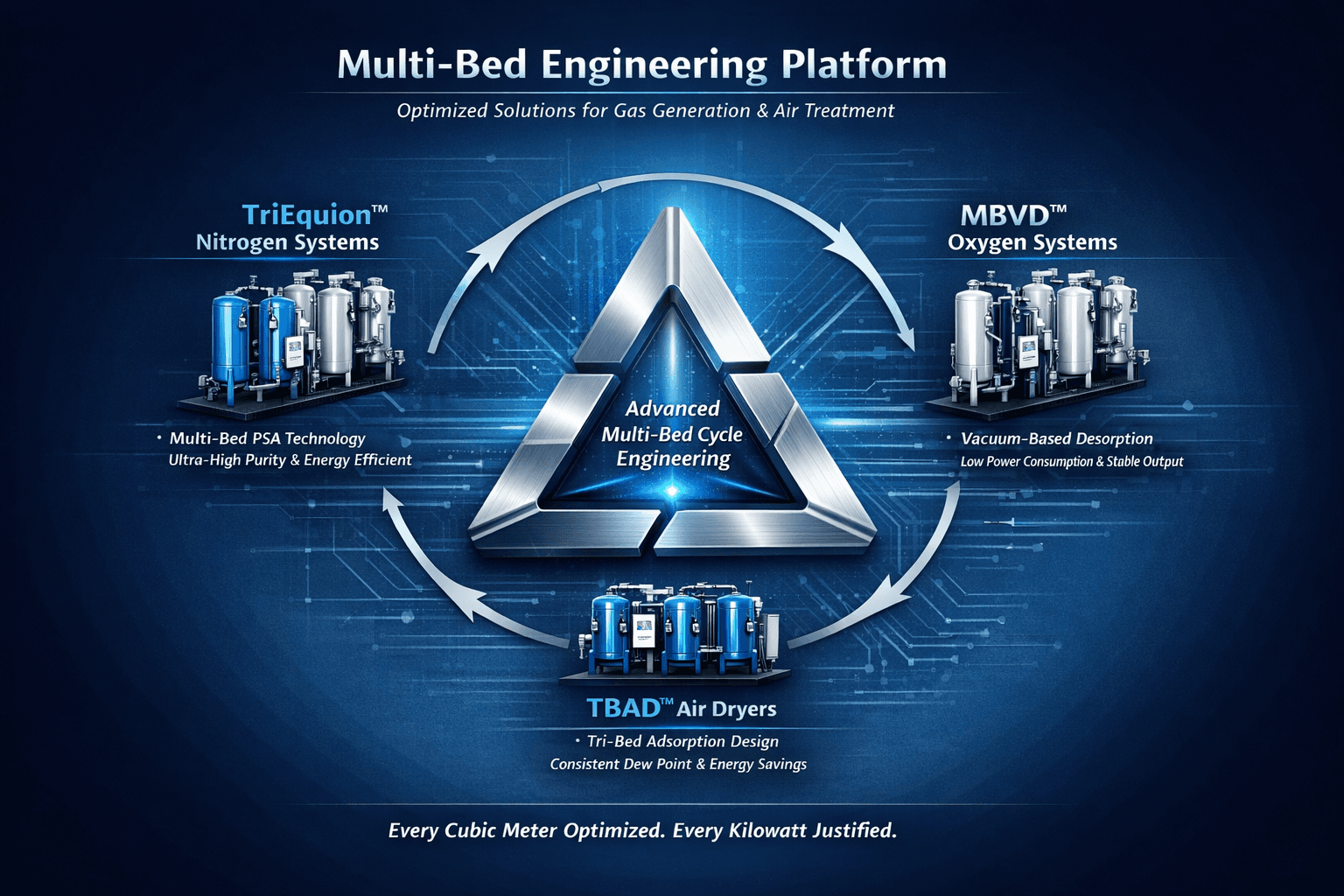
Air factor (air-to-product ratio) is the volume of compressed air required per unit of nitrogen or oxygen product; a lower air factor means less compressor power for the same gas output. Multi-bed equalization and efficient regeneration (as in advanced PSA/VPSA designs) reduce air factor, which is why cycle engineering is central to on-site gas generation energy cost.